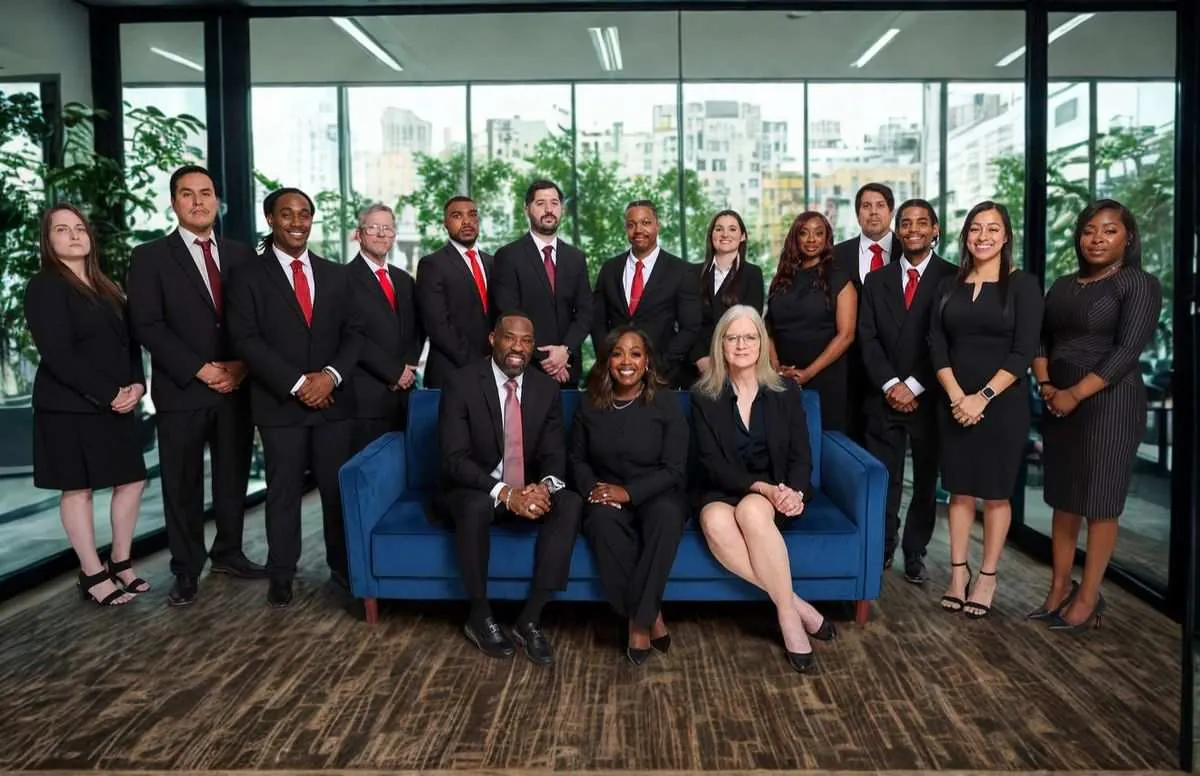

L and L Law Group, PLLC is a Frisco, Texas criminal defense firm representing clients across the nine-county DFW metroplex and in the U.S. District Courts for the Northern and Eastern Districts of Texas. The firm is co-founded by Reggie London (Texas Bar No. 24043514, former Dallas County Assistant District Attorney) and Njeri London (Texas Bar No. 24043266, admitted TXND, TXED, and the 5th Circuit). Every retained matter is handled personally by one or both partners. We accept misdemeanor and felony cases across the full Texas Penal Code and Health & Safety Code spectrum, including DWI, drug crimes, family violence, sex offenses, weapons charges, federal indictments, juvenile cases, expunction and non-disclosure, and post-conviction appeals and habeas.
What a criminal defense lawyer actually does
A Texas criminal defense lawyer’s job is structurally narrow: protect the client’s constitutional rights, force the State to its proof on every element of every charge, and negotiate or litigate the best available outcome. The job is procedurally broad: it covers the moment of arrest through the final appellate writ, with dozens of decision points along the way that affect the eventual sentence by years — sometimes decades.
The work breaks into roughly six phases: pre-charge representation (target letters, grand jury subpoenas, custodial interview requests); bond and pretrial conditions (magistration, § 17.15 bond-amount challenges, condition modifications); discovery and motion practice (Michael Morton Act compliance under Tex. Code Crim. Proc. art. 39.14, suppression under art. 38.23, motions in limine, motions for severance); plea negotiation (charge reductions, pretrial diversion, deferred adjudication, agreed sentencing recommendations); trial in chief (voir dire, opening statement, cross-examination, defense case-in-chief, closing argument, jury charge conferences); and sentencing, appeal, or post-conviction relief (sentencing memoranda, notice of appeal, Tex. Code Crim. Proc. art. 11.07 state habeas, 28 U.S.C. § 2254 federal habeas).
Why direct attorney access matters
One of the structural problems with high-volume defense practice is that the client often does not speak to the attorney they retained until well into the case. Intake staff handle the first call, junior associates handle the docket appearances, and by the time the trial date arrives the lead attorney is meeting the client for the second or third time. We do not operate that way. Every consult, every court appearance, every plea decision, every trial moment is handled by one or both founding partners. There is no intake clerk gate, no junior-associate handoff, no "you’ll meet the lead attorney closer to trial" lag.
Selecting a defense lawyer — what to look for
Choosing criminal-defense counsel in Texas is consequential and confusing. A few practical criteria that we believe matter more than marketing optics:
- Bar admissions that match your case. Federal cases require federal admissions. A Texas state-court lawyer cannot appear in TXND or TXED without separate admission. Verify the lawyer’s admissions match where your case sits.
- Direct attorney communication. Ask at the consult who will appear at hearings and answer calls between hearings. The honest answer is sometimes "an associate"; a transparent answer to that question is itself diagnostic.
- Flat-fee structure. Hourly billing in criminal defense creates the wrong incentives because the State controls the pace. A flat fee aligns the lawyer’s incentive with prompt resolution.
- Specific experience in your charge category. A general criminal-defense practice handles most charges adequately; the high-stakes categories (federal trafficking, sex offenses, family violence, intoxication manslaughter, capital cases) reward subject-matter depth.
- Local court familiarity. Texas criminal courts vary by county in scheduling, prosecutor practice, judicial sentencing tendencies, and acceptable negotiation postures. Counsel who appears regularly in the specific court matters.
Misdemeanors vs felonies — the line that drives everything
The Texas Penal Code classifies offenses into eight punishment categories: Class C misdemeanor (fine-only, up to $500); Class B misdemeanor (up to 180 days county jail, $2,000 fine); Class A misdemeanor (up to 1 year, $4,000 fine); state-jail felony (180 days to 2 years state-jail facility, up to
What we defend
We handle the full spectrum of Texas criminal cases. Co-founders Reggie and Njeri London handle cases with attorney-level review at every stage.
State-court practice
- DWI and intoxication offenses — Penal Code Chapter 49. See DWI defense
- Drug offenses — H&S Code Chapter 481. See drug crimes
- Assault and family violence — Penal Code Chapter 22. See family violence
- Property crimes — theft (Chapter 31), burglary (§ 30.02), robbery (§ 29.02)
- Sex offenses — Penal Code Chapters 21 and 22
- Weapons charges — Penal Code Chapter 46, post-HB 1927 permitless carry analysis
- Homicide — Penal Code Chapter 19, including murder (§ 19.02), capital murder (§ 19.03), manslaughter (§ 19.04)
Federal-court practice
We also handle federal indictments in the Northern District of Texas (TXND) and Eastern District of Texas (TXED). Federal cases differ from state practice in discovery, sentencing, and trial procedure. See our federal defense page.
Collateral relief and post-conviction
- Expunction and nondisclosure — CCP Chapter 55 and Government Code § 411.0735
- ALR license-suspension hearings — Transportation Code Chapters 524 and 724
- Probation violation defense — CCP Chapter 42A motions to revoke and adjudicate
- Juvenile defense — Family Code Title 3
Free consultation
Call (972) 370-5060 for a free, direct-to-attorney case review.
0,000); third-degree felony (2 to 10 years TDCJ, up toMore Areas We Defend
We handle the full spectrum of Texas criminal cases. Co-founders Reggie and Njeri London handle cases with attorney-level review at every stage.
More on State-Court Practice
- DWI and intoxication offenses — Penal Code Chapter 49. See DWI defense
- Drug offenses — H&S Code Chapter 481. See drug crimes
- Assault and family violence — Penal Code Chapter 22. See family violence
- Property crimes — theft (Chapter 31), burglary (§ 30.02), robbery (§ 29.02)
- Sex offenses — Penal Code Chapters 21 and 22
- Weapons charges — Penal Code Chapter 46, post-HB 1927 permitless carry analysis
- Homicide — Penal Code Chapter 19, including murder (§ 19.02), capital murder (§ 19.03), manslaughter (§ 19.04)
More on Federal-Court Practice
We also handle federal indictments in the Northern District of Texas (TXND) and Eastern District of Texas (TXED). Federal cases differ from state practice in discovery, sentencing, and trial procedure. See our federal defense page.
Collateral relief and post-conviction (Section 2)
- Expunction and nondisclosure — CCP Chapter 55 and Government Code § 411.0735
- ALR license-suspension hearings — Transportation Code Chapters 524 and 724
- Probation violation defense — CCP Chapter 42A motions to revoke and adjudicate
- Juvenile defense — Family Code Title 3
Free consultation (Section 2)
Call (972) 370-5060 for a free, direct-to-attorney case review.
0,000); second-degree felony (2 to 20 years); first-degree felony (5 to 99 years or life); and capital felony (life without parole or death). The classification — not the colloquial offense name — drives the punishment exposure and most of the procedural decisions.The misdemeanor/felony line is the single most important categorical distinction because it changes the court (county court at law for misdemeanors, district court for felonies), the requirement of a grand jury indictment (felonies require it; misdemeanors do not), the available pretrial diversion programs, the appellate route, and the collateral consequences. A first-offense Class A misdemeanor — even one carrying up to a year in jail — rarely results in incarceration. A first-offense state-jail felony for the same conduct (e.g., drug possession of a slightly higher quantity) carries presumed jail time absent successful negotiation.
The collateral consequences nobody warns you about
A Texas criminal conviction triggers a long list of statutory consequences beyond the sentence itself: federal firearms ban for any felony or for misdemeanor crimes of domestic violence under 18 U.S.C. § 922(g); professional licensing review by every Texas board (medical, nursing, real-estate, insurance, accounting, education) under the agency’s own moral-character standard; immigration consequences for non-citizens under 8 U.S.C. § 1227 and 1182, with many offenses triggering removability or inadmissibility; federal-employment restrictions for many federal positions and contractor roles; educational consequences for federal student-aid eligibility and graduate-school admissions; and housing impacts through tenant-screening services that report criminal-history matches for years after the case ends.
Most of these consequences are not addressed in plea negotiations because they fall outside the criminal court’s jurisdiction. Counsel who knows the consequences flags them at the plea stage so the client can make an informed decision about whether the plea avoids one trap but walks into another.
The L and L Law Group engagement
Initial consultations are free, conducted by an attorney (not an intake clerk), and confidential. We review the facts as you understand them, identify the realistic case posture, and either quote a flat fee for representation or tell you frankly that we are not the right firm for the case. If we are not the right firm, we refer to one we trust. The fee, where one is quoted, is documented in writing in a Texas-state-bar-compliant engagement agreement and covers the entire defense through final disposition or trial in chief on the underlying charge.
Phone: (972) 370-5060 — direct to attorney, 24 hours a day, seven days a week. Office: 5899 Preston Rd, Suite 101, Frisco, TX 75034 (by appointment).
Talk to a criminal defense attorney today
Free, confidential consultation. We answer the phone — no intake clerks, no callbacks-when-convenient.
Call (972) 370-5060Frequently asked
How quickly can I speak to a lawyer after an arrest?
The direct line at (972) 370-5060 reaches an attorney 24/7. We routinely take post-arrest calls from holding facilities. The first conversation typically covers bond, magistration, the immediate next steps, and a brief assessment of the case posture.
What does a free consultation include?
A 30- to 45-minute conversation, by phone or in person, with one of the founding partners. We listen to the facts as you understand them, explain the realistic case posture, identify the most pressing deadlines, and quote a flat fee if we are the right firm for the matter.
Do you handle federal cases?
Yes. Njeri is admitted to the U.S. District Courts for the Northern (TXND) and Eastern (TXED) Districts of Texas and to the U.S. Court of Appeals for the Fifth Circuit. We do not refer federal cases out.
What if I cannot afford private counsel?
The court will appoint counsel for indigent defendants under Tex. Code Crim. Proc. art. 26.04 or, in federal cases, under the Criminal Justice Act, 18 U.S.C. § 3006A. The court determines indigency based on income and assets.
Do you take cases outside the nine DFW counties?
Occasionally on referral or for existing clients. The default coverage is Collin, Dallas, Denton, Tarrant, Rockwall, Kaufman, Ellis, Johnson, and Hunt Counties plus TXND and TXED federal. We can refer cases outside that footprint to vetted counsel.
How is the flat fee determined?
By case factors at the consult: charge classification, case complexity, county of arrest, anticipated motion practice, expert-witness needs, and whether the case is likely to plead or proceed to trial. The fee is quoted in writing in the engagement agreement.
Should I answer police questions before I have a lawyer?
No. You have the right to remain silent under the Fifth Amendment, and Texas law strictly limits how statements made in custody can be used — see Tex. Code Crim. Proc. art. 38.22. Identify yourself, state clearly that you want a lawyer, and stop talking. Polite silence cannot be used against you at trial; an unguarded statement almost always can be.
What happens at the first court setting?
In Collin, Dallas, Denton, and Tarrant Counties the first setting is an announcement or status setting, not a trial — no witnesses testify. The court confirms counsel, reviews bond conditions, and starts the discovery clock under art. 39.14, the Michael Morton Act. Most cases go through several settings before any plea or trial decision has to be made.
What types of criminal cases does the firm handle?
The full Texas Penal Code and Health & Safety Code spectrum: DWI, drug possession, theft and property offenses, assault and family violence, weapons charges, sex offenses, juvenile matters, probation revocations, and expunctions, plus federal cases in the Northern and Eastern Districts of Texas. Each practice area has its own page on the practice areas hub.
In our practice defending Texas criminal cases, we have represented clients in Collin, Dallas, Denton, and Tarrant County criminal courts on the full Texas Penal Code and Health & Safety Code spectrum. Reggie's prosecutor background in Dallas County means we know the State's evidentiary playbook; Njeri's trial-trained motion practice anchors the suppression-driven defense work.
About the Authors


Talk to an attorney — not a screener.
Tell us about your case. Most clients hear back within an hour. Often within minutes.