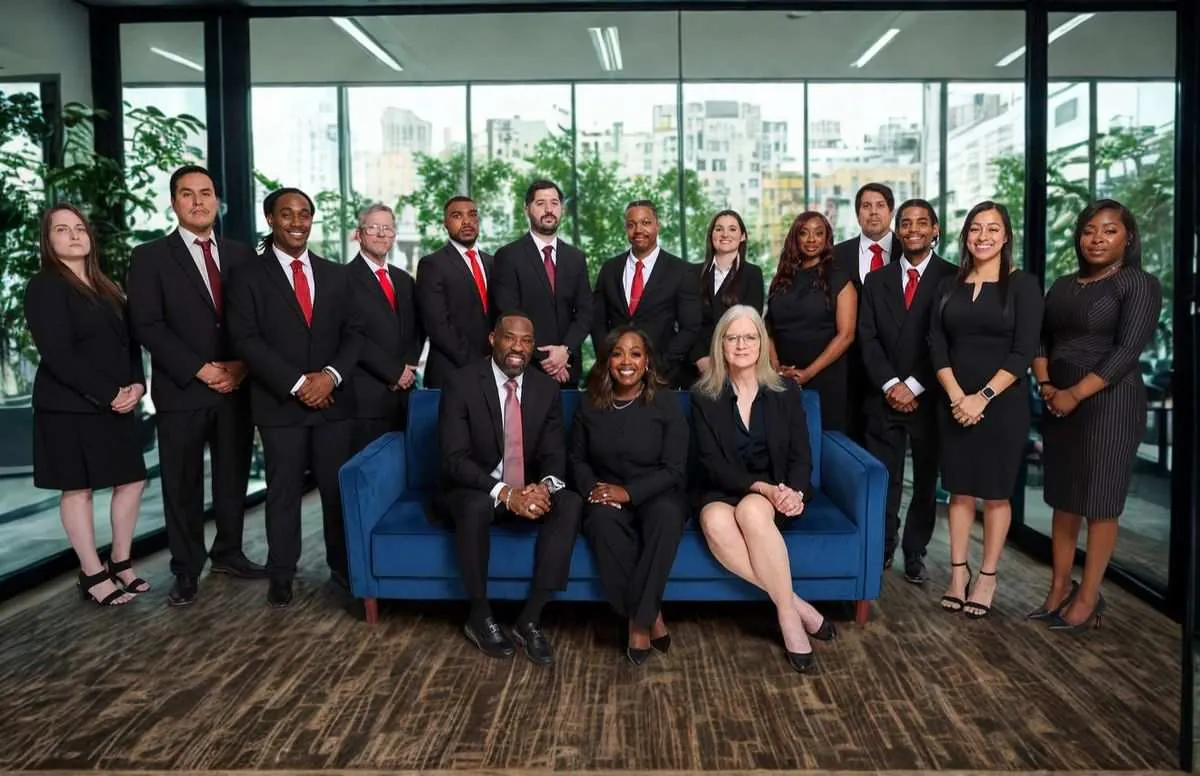
Dallas Criminal Defense Lawyers
Direct-to-attorney criminal defense for Dallas arrests and Dallas County criminal-court matters. Co-founders Reggie and Njeri London handle every retained case personally — from arraignment through trial or appeal — from our Frisco office, 30 miles from Dallas.
L and L Law Group represents clients arrested in Dallas, Texas and clients facing charges in the Frank Crowley Courts Building on the full Texas Penal Code and Health & Safety Code spectrum. Founding partners Reggie London (Texas Bar No. 24043514, former Dallas County Assistant District Attorney) and Njeri London (Texas Bar No. 24043266, admitted TXND, TXED, 5th Circuit) personally handle every Dallas matter. Our office is in Frisco, 30 miles from Dallas (40 minutes). Free 24/7 consultation: (972) 370-5060.
Common Dallas criminal charges we defend
Nearly every assumption people bring to a Dallas criminal case rests on one belief: that a Dallas address means a Dallas County case. For roughly 84,000 residents it does not. The City of Dallas spans five counties, and the Census Bureau’s 2024 place-within-county tabulation shows how the city’s population actually divides.
| County containing part of the City of Dallas | City residents there, 2024 |
|---|---|
| Dallas County | 1,242,071 |
| Collin County | 54,194 |
| Denton County | 29,822 |
| Kaufman County | 0 |
| Rockwall County | 0 |
The Collin and Denton numbers are not a rounding error. They are about 84,000 people with a Dallas address whose criminal case never reaches the Frank Crowley Courts Building. A case arising in a far-north Dallas neighborhood that sits in Collin or Denton County is filed in McKinney or in Denton instead: a different courthouse, a different District Attorney, and a different set of judges from a case arising a few miles south. Every program described further down this page is a Dallas County program. None of it travels north with you.
Three buildings, three different jobs
Inside Dallas County the confusion changes shape rather than disappearing, because the city and the county each run their own machinery out of separate addresses.
- Dallas Municipal Court, 2014 Main Street, Dallas, Texas 75201
- The City of Dallas court. Court and Detention Services handles its administrative and clerical functions alongside the Dallas Marshal’s Office, the City Detention Center and building security, and describes itself as the Official Clerk of the Court of Record. This municipal court is a court of record.
- Lew Sterrett Justice Center, 111 West Commerce Street
- The Dallas County jail, and also the home of the county’s Magistrate Court. First appearances happen here, at the jail. The District Clerk is custodian of record for that Magistrate Court as well as for the felony courts.
- Frank Crowley Courts Building, 133 N. Riverfront Boulevard, Dallas, TX 75207
- The single location for Dallas County criminal cases. The County Criminal Courts and the Criminal District Courts both sit here, along with the District Clerk and County Clerk criminal offices and the Criminal District Attorney’s office.
A felony defendant is therefore magistrated on Commerce Street while the case file itself lives on Riverfront Boulevard, and a fine-only citation is answered on Main Street. The City of Dallas also operates its own City Detention Center and Marshal’s Office under Court and Detention Services, a separate system from the Dallas County Sheriff’s jail. Searching one system for someone held in the other is an ordinary first-night mistake.
Which bench, and how many there are
- Felonies go to one of seventeen benches: Criminal District Courts No. 1 through 7, plus the 194th, 195th, 203rd, 204th, 265th, 282nd, 283rd, 291st, 292nd and 363rd District Courts.
- Class A and Class B misdemeanors go to one of eleven County Criminal Courts.
- Fine-only appeals land somewhere most people never hear about. Dallas County maintains two Criminal Courts of Appeals that hear appeals from justice of the peace courts and city municipal courts, so a Class C conviction out of Dallas Municipal Court is appealed within the county to a dedicated appellate county court.
The 120-day door
The most consequential deadline in a Dallas County felony has nothing to do with trial. The District Attorney’s Restorative Justice Division runs felony pre-trial diversion using a validated risk and need assessment, and referrals must be submitted either before indictment or within 120 days of indictment. The assessment is free but requires a signed waiver, and the process is aimed at first-time, non-violent offenders. Referral forms go to JailDiversion@dallascounty.org. The county describes successful completion as ending in dismissal, with the participant then eligible to apply for expunction. Because that clock runs from indictment rather than arrest, it can expire while a case looks quiet.
What is written on the charging instrument then decides which specialty door the referral can point at.
- A first felony with a substance use disorder diagnosis. DIVERT Court is Dallas County’s pre-trial diversion specialty court and adult drug court for first-time felony non-aggravated offenders carrying that diagnosis.
- A first felony at ages 17 to 24. The Youthful Offender Court takes first-time felony non-aggravated cases inside that age band.
- A case driven by diagnosed mental illness. MHJD Court covers felony and misdemeanor mental health dockets, alongside AIM Court (Achieve, Inspire, Motivate) and SET Court (Stabilization, Engagement, Transition). The Mental Health Division seeks alternatives to jail for defendants held because of diagnosed mental illness, using tailor-made Mental Health Pre-Trial Intervention Agreements. Eligibility line 214-366-9407, or 877-653-6363 toll free.
- A veteran’s case. The Dallas County Veterans Treatment Court is open to veterans eligible for VA benefits, on misdemeanor or felony charges, where a mental health condition or drug dependence was caused or worsened by military service.
- A prostitution charge. All felony prostitution cases, regardless of criminal history, are offered a Pre-Trial Intervention Agreement conditioned on completing the STAR Court program, and all misdemeanor prostitution cases are offered a 90-to-120-day agreement. A separate STOP class is an eight-hour quarterly class for male consumers charged with solicitation.
- A misdemeanor with no prior record. The District Attorney offers Pre-Trial Intervention to first-time misdemeanor offenders, with eligibility reviewed by the Assistant District Attorney assigned to that court.
One charging decision worth knowing about
Dallas County reported the first Dallas County prosecution under the murder statute Texas enacted in 2023 for deaths caused by illegally delivered controlled substances, and the District Attorney’s office announced a conviction and sentence in that case. For anyone accused of sharing or selling a substance someone later died from, the practical point is that the indictment here may not carry a drug charge at all. Charge selection, not only the underlying conduct, is part of what has to be answered early.
Whether the matter is a citation on Main Street, a misdemeanor in one of the eleven County Criminal Courts, or a felony on one of the seventeen district benches, the first question we answer on a Dallas file is which county actually holds it. You can review the full range of charges we defend, and if the address involved sits north of the county line, say so on the first call. It changes the answer to nearly everything after it.
Dallas criminal defense FAQs
My mail comes to a Dallas address but my paperwork says Collin County. Is that a mistake?
Almost certainly not. The City of Dallas spans five counties: Dallas, Collin, Denton, Kaufman and Rockwall. The Census Bureau’s 2024 place-within-county figures put 1,242,071 city residents in Dallas County, 54,194 in Collin County and 29,822 in Denton County. That is roughly 84,000 people with a Dallas address whose criminal case is filed outside Dallas County. A case arising in a far-north Dallas neighborhood inside Collin or Denton County goes to McKinney or to Denton, which means a different courthouse, a different District Attorney and a different set of judges.
Do the Kaufman County and Rockwall County parts of Dallas ever matter for a criminal case?
In population terms, not so far. The Census Bureau’s 2024 tabulation of the City of Dallas by county shows the Kaufman County and Rockwall County portions at zero residents, with the entire city population divided among Dallas, Collin and Denton Counties. We have not separately verified whether city land area extends into those two counties even though nobody is counted as living there. The routing question that actually comes up in Dallas practice is the Collin and Denton line to the north, not the eastern edge of the city.
Does the county line change anything about a Dallas DWI?
It changes who prosecutes it and where you go. A driving while intoxicated case arising in the Dallas County part of the city is filed at the Frank Crowley Courts Building, handled by the Dallas County Criminal District Attorney, and heard in one of eleven County Criminal Courts as a Class A or B misdemeanor, or on one of seventeen felony benches if charged higher. The same stop a few blocks north in Collin or Denton County means a different District Attorney and a different courthouse. Our page on a Texas DWI charge covers the substance; the county decides the venue.
After a Dallas arrest, is my relative at the county jail or at the city detention center?
Those are two different systems, which is why the first night goes badly so often. County-level custody for a Dallas County case is the Lew Sterrett Justice Center at 111 West Commerce Street, and Dallas County publishes an online jail lookup for it. Separately, the City of Dallas operates its own City Detention Center and Dallas Marshal’s Office under the Court and Detention Services department, which is not the Dallas County Sheriff’s jail system. And if the case filed in Collin or Denton County, county custody is up there rather than on Commerce Street.
Why is the first hearing at the jail instead of at the courthouse?
Because in Dallas County the Magistrate Court sits inside the Lew Sterrett Justice Center at 111 West Commerce Street, while the felony case itself lives at the Frank Crowley Courts Building on North Riverfront Boulevard. The Dallas County District Clerk is custodian of record for both the felony courts and that Magistrate Court, so a single office holds paperwork generated in two buildings. Knowing which building produced a given document saves a wasted trip, and it explains why the address on a bond paper often does not match the address on a court setting.
How long do I have to ask for felony pre-trial diversion in Dallas County?
The referral has to be submitted either before indictment or within 120 days of indictment. That is the entire window. The District Attorney’s Restorative Justice Division runs the program using a validated risk and need assessment, which is free but requires a signed waiver, and the process is aimed at first-time, non-violent offenders. Referral forms go to JailDiversion@dallascounty.org. Dallas County describes successful completion as ending in dismissal, with the participant then eligible to apply for expunction. Because the clock runs from indictment rather than from arrest, it can expire during a stretch when the case looks quiet.
More Dallas questions
Which Dallas County court hears a Class A or Class B misdemeanor?
One of eleven County Criminal Courts, all housed at the Frank Crowley Courts Building at 133 N. Riverfront Boulevard. Frank Crowley is the single location for Dallas County criminal cases, so those courts and the seventeen Criminal District Courts that hear felonies sit in one building, as do the District Clerk and County Clerk criminal offices. That is convenient once you are inside and confusing before you are, because the clerk you need depends on whether the case is a misdemeanor or a felony rather than on which floor you happen to be standing on.
Can a Dallas Municipal Court conviction be appealed?
Yes, and Dallas County keeps courts dedicated to that work. Alongside its eleven County Criminal Courts, the county maintains two Criminal Courts of Appeals that hear appeals from justice of the peace courts and city municipal courts. So a fine-only conviction out of Dallas Municipal Court at 2014 Main Street is appealed within Dallas County to a dedicated appellate county court rather than to a general misdemeanor docket. Dallas Municipal Court is also a court of record, with Court and Detention Services describing itself as the Official Clerk of the Court of Record.
I am 22 and this is my first felony charge in Dallas County. Is there a program?
There may be two. The Youthful Offender Court is a Dallas County pre-trial diversion specialty court for 17-to-24-year-olds facing a first-time felony non-aggravated case. Separately, DIVERT Court is the county’s pre-trial diversion specialty court and adult drug court for first-time felony non-aggravated offenders with a substance use disorder diagnosis, so a case involving substance use can fit either track. Both are reached through the District Attorney’s felony pre-trial diversion referral, which carries the same cutoff: pre-indictment, or within 120 days of indictment. Raise it early rather than at a trial setting.
What if diagnosed mental illness is behind the charge?
Dallas County runs several dockets for exactly that. MHJD Court, the mental health jail diversion court, covers both felony and misdemeanor mental health dockets, and the county also operates AIM Court, for Achieve, Inspire, Motivate, and SET Court, for Stabilization, Engagement, Transition. The District Attorney’s Mental Health Division seeks alternatives to jail for defendants in custody because of diagnosed mental illness, using tailor-made Mental Health Pre-Trial Intervention Agreements rather than one fixed program. The services and eligibility line is 214-366-9407, or 877-653-6363 toll free. Documentation of the diagnosis is usually what moves an application forward.
What does Dallas County do with a prostitution or solicitation charge?
It handles them on a published track. All felony prostitution cases, regardless of criminal history, are offered a Pre-Trial Intervention Agreement conditioned on completing the STAR Court program, and all misdemeanor prostitution cases are offered a 90-to-120-day Pre-Trial Intervention Agreement. The county describes successful completion as ending in dismissal, with the participant then immediately eligible to apply for expunction. A separate STOP class is an eight-hour quarterly class for male consumers charged with solicitation. Our Texas expunction and record-clearing page explains what applying actually involves.
Where do I get Dallas County criminal records, and can they be cleared later?
Two offices, one building. Misdemeanor records are held by the County Clerk on the second floor of Frank Crowley at (214) 653-5767 or (214) 653-5762, and felony records by the District Clerk’s Felony Records Desk at 214-653-5950. Dallas County online criminal case information reaches back to 1975, and case record documents are available for most felony cases filed after 2009. On clearing a record, the county and the District Clerk run an annual Expunction Expo, announced as its tenth, reporting more than 3,300 expunctions granted since it began. Our expunction page covers eligibility.
Arrested in Dallas?
Free, confidential consultation — direct to attorney, 24/7. We pick up jail-release calls at all hours.
Call (972) 370-5060Why a Dallas charge runs through Frank Crowley
As the seat of Dallas County, Dallas sends its felony and Class A and B misdemeanor cases to one building: the Frank Crowley Courts Building, where the Dallas County District Attorney files and prosecutes them. If you are booked after an arrest in the city, pretrial detention runs through the county jail at the Lew Sterrett Justice Center before a case ever reaches a courtroom. Because this is the largest city in the region, the volume of matters moving through Frank Crowley is heavy, and which specific court a file is assigned to does a lot to shape how quickly it moves and how it gets handled.
That scale also changes how a case begins on the street. Dallas is patrolled by multiple Dallas Police Department divisions, each covering its own slice of the city, so the section of town where a stop happens often shapes who makes the arrest and how the report reads. Traffic and DWI enforcement clusters on the corridors that thread the city — I-30 and I-35E, US-75 up the Central Expressway spine, I-45 heading south, the I-635 LBJ loop along the north, and the Dallas North Tollway. A stop on one of these arteries is a routine starting point for a county-level charge.
Separate from all of that is the City of Dallas Municipal Court, which is a different track entirely. It handles only Class C, fine-only matters — traffic citations and city-ordinance offenses — and it never touches the felonies and jailable misdemeanors that go to Frank Crowley. Confusing the two is a common early mistake. Knowing in advance whether a charge belongs in municipal court or in the county system at Frank Crowley tells you which deadlines apply, what a first setting will look like how much is actually at stake.
For someone charged in Dallas, the practical reality is a large, fast-moving county system rather than a small-town docket. Our team works cases at Frank Crowley and tracks how the individual courts there differ in pace and practice, and we account for which patrol division and which highway corridor produced the stop. If you are facing a charge out of Dallas, you can reach us at (972) 370-5060 to talk through where your case is headed and what the next setting requires.
About the Authors


Criminal Charges We Defend in Dallas
L&L Law Group represents clients throughout Dallas and Dallas County against the full range of Texas criminal charges. These are the charges our defense team handles most often — or call (972) 370-5060 for a free, confidential consultation.